LiFePO4 vs Lead Acid Battery: Complete Comparison for Solar
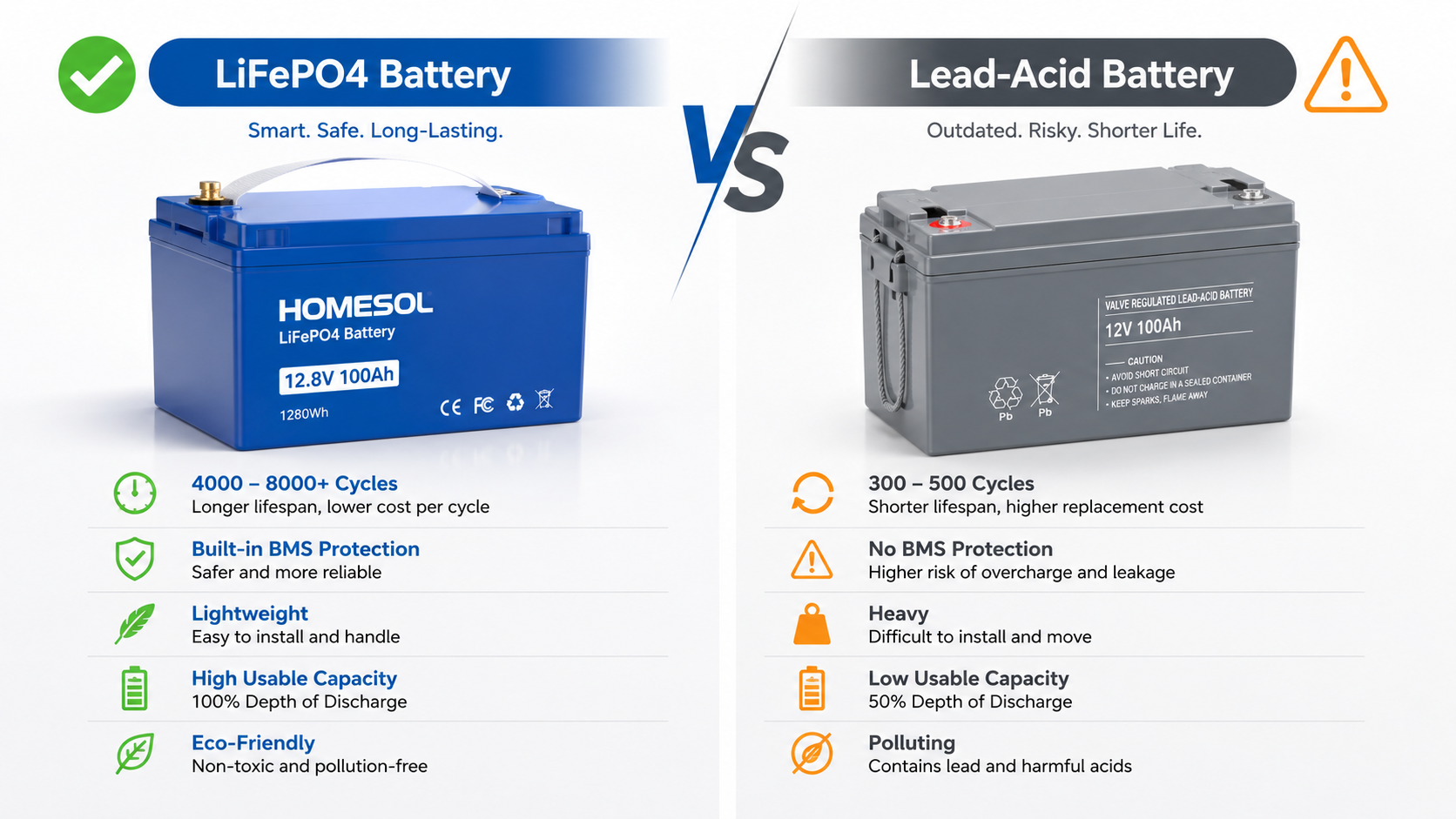
Choosing between LiFePO4 and lead acid batteries is one of the most important decisions for any solar energy storage project. This complete comparison covers cycle life, efficiency, cost, safety, and weight — helping you decide which battery type is best for your specific application.
1. Cycle Life: LiFePO4 Wins by 5x
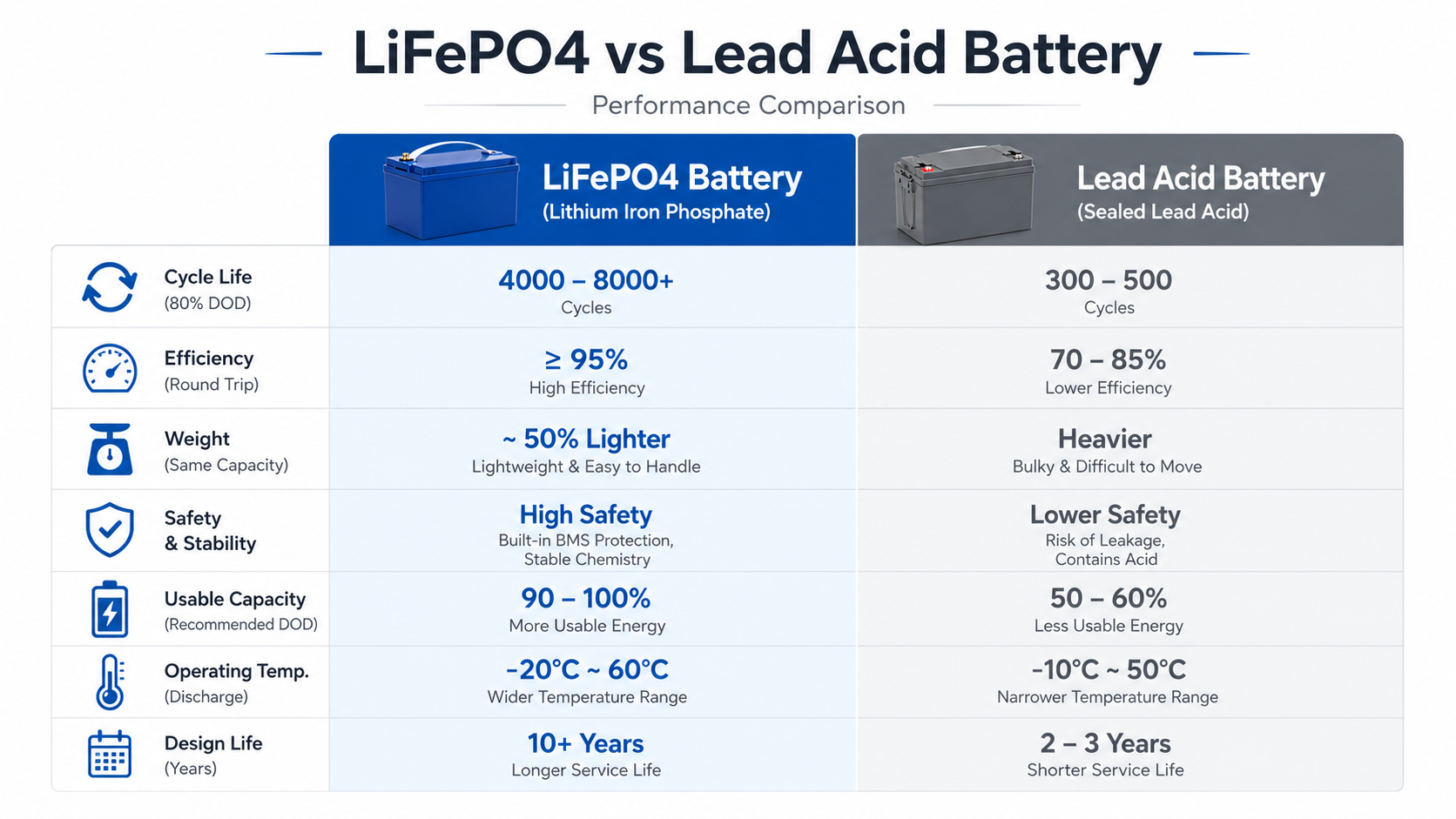
Cycle life determines how many times a battery can be charged and discharged before its capacity drops below 80%. This directly impacts your total cost of ownership.
| Battery Type | Cycle Life | Lifespan |
|---|---|---|
| LiFePO4 | 6,000+ cycles @ 80% DOD | 10-15 years |
| Lead Acid (AGM) | 500-1,000 cycles @ 50% DOD | 3-5 years |
| Lead Acid (Gel) | 800-1,200 cycles @ 50% DOD | 4-6 years |
| Lead Acid (Flooded) | 1,000-1,500 cycles @ 50% DOD | 4-7 years |
Key insight: LiFePO4 batteries can be discharged to 80% depth of discharge (DOD) regularly, while lead acid batteries should only be discharged to 50% DOD to avoid damage. This means you need twice the capacity with lead acid to get the same usable energy.
2. Efficiency and Usable Energy
Battery efficiency (also called round-trip efficiency) measures how much energy you get back when you discharge the battery compared to what you put in during charging.
| Battery Type | Round-Trip Efficiency | Energy Loss |
|---|---|---|
| LiFePO4 | 92-95% | 5-8% |
| Lead Acid | 80-85% | 15-20% |
Round-trip efficiency varies by battery design, temperature, current and operating window. For current HOMESOL LiFePO4 buyer-facing content, use 92–95% battery efficiency unless a model-specific confirmed value is supplied.
3. Total Cost of Ownership
For B2B purchasing, compare total ownership cost using the same application, usable energy target and service period. Avoid choosing a battery only by the initial unit price.
| Buyer Check | LiFePO4 | Lead Acid |
|---|---|---|
| Usable energy planning | Check model-specific usable capacity and BMS limits | Check recommended depth of discharge and application duty |
| Maintenance | Typically lower routine maintenance | Depends strongly on battery type and installation |
| Efficiency | 92–95% for current HOMESOL buyer-facing content | Use supplier-confirmed data for the exact battery |
| Replacement planning | Evaluate warranty, cycle specification and operating conditions | Evaluate the same factors on an equivalent usable-energy basis |
4. Safety and System Integration
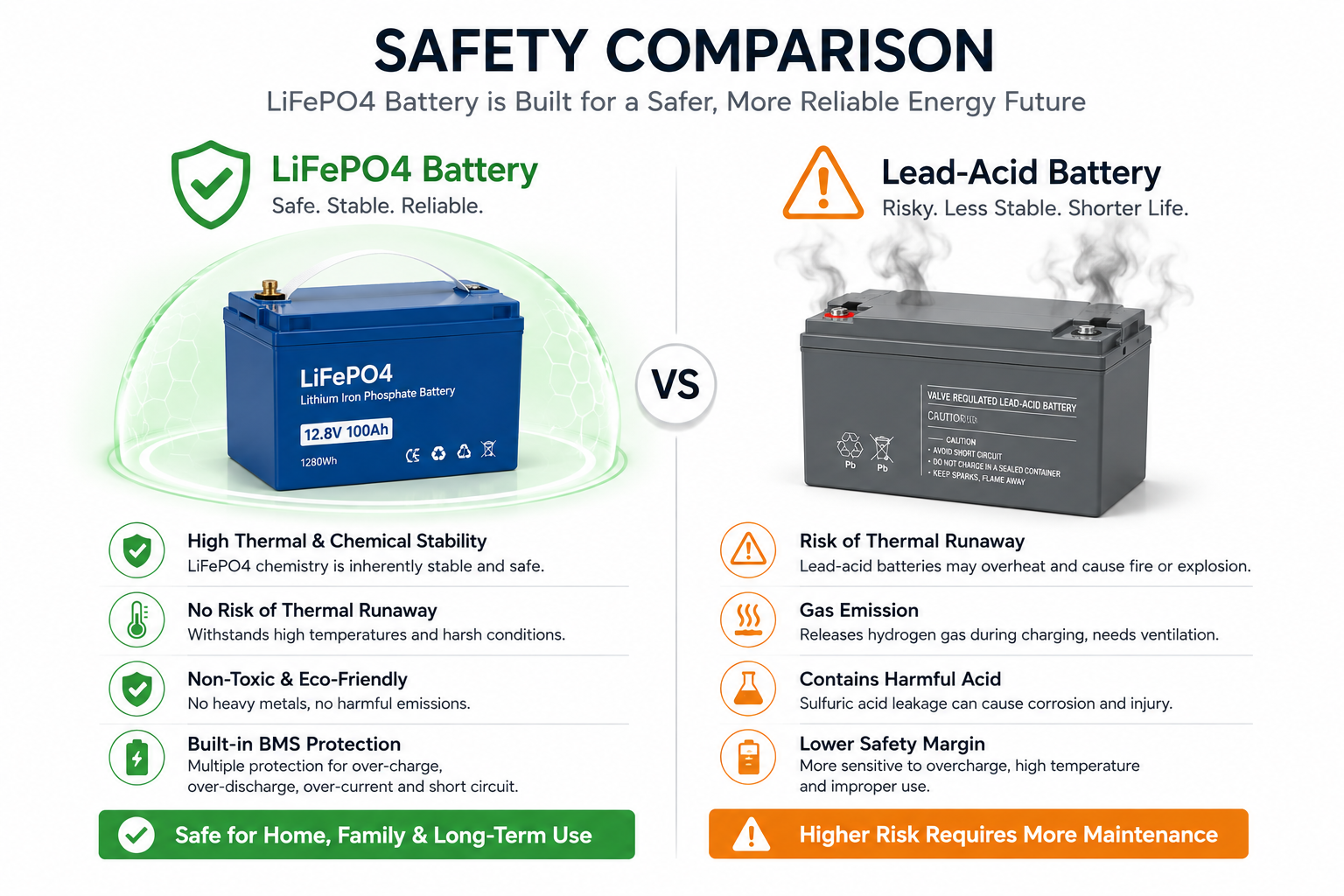
Safety is critical for residential and commercial solar installations.
| Safety Factor | LiFePO4 | Lead Acid |
|---|---|---|
| Thermal Runaway Risk | Very Low | Moderate |
| Gassing | None | Hydrogen gas (explosive) |
| Spillage Risk | None (sealed) | Acid spillage (corrosive) |
| Operating Temperature | 0°C to 50°C | -15°C to 45°C |
5. Weight and Size
| Battery Type | Weight (per kWh) | Size Comparison |
|---|---|---|
| LiFePO4 | 5-7 kg/kWh | Compact, wall-mountable |
| Lead Acid | 25-35 kg/kWh | Bulkier, floor-mounted |
LiFePO4 batteries are 70-80% lighter than lead acid batteries. This matters for wall-mounted installations, structural load limits, and transportation costs.
6. When Lead Acid Might Be Better
Despite LiFePO4's advantages, lead acid still has a place in certain scenarios:
- Very tight budget: If upfront cost is the only constraint
- Temporary installations: Construction sites, events
- Extreme cold: Lead acid performs better below -10°C
- Small backup systems: UPS applications under 1kWh
Our Recommendation
For many modern solar-storage projects, LiFePO4 is a strong option when the inverter, BMS, voltage and application requirements are correctly matched. The lower total cost of ownership, longer lifespan, better safety, and higher efficiency make it the smart investment for residential and commercial applications.
HOMESOL offers LiFePO4 battery platforms for energy-storage applications. Confirm cycle-life specifications and operating conditions on the exact current product page or datasheet. The current standard battery warranty is 5 years.
Current HOMESOL LiFePO4 examples: review the EB 25.6V 200Ah battery, EB 51.2V 300Ah Type 1 and EB 51.2V 300Ah Type 2. The two 300Ah pages represent different physical cabinet versions.
Need product pricing or model selection support?
Explore HOMESOL inverter and LiFePO4 battery solutions, or send your target model, market and estimated quantity for a wholesale quotation.